Endpoint Agent
The endpoint agent runs on Windows systems and is responsible for collecting telemetry, applying local logic, and sending investigation-ready alerts to the backend.
Responsibilities
- Read Sysmon events from the local endpoint
- Normalize event fields into a stable schema
- Evaluate JSON detection rules
- Build alert context such as process lineage and timestamps
- Queue and upload alerts over HTTPS
- Report agent health and sync status
Telemetry sources
The agent is designed around Sysmon-driven visibility, including:
- Process creation
- Network connections
- Image loads
- File create and delete activity
- Registry changes
- DNS queries
- Process access activity
- Process tampering signals
Agent architecture
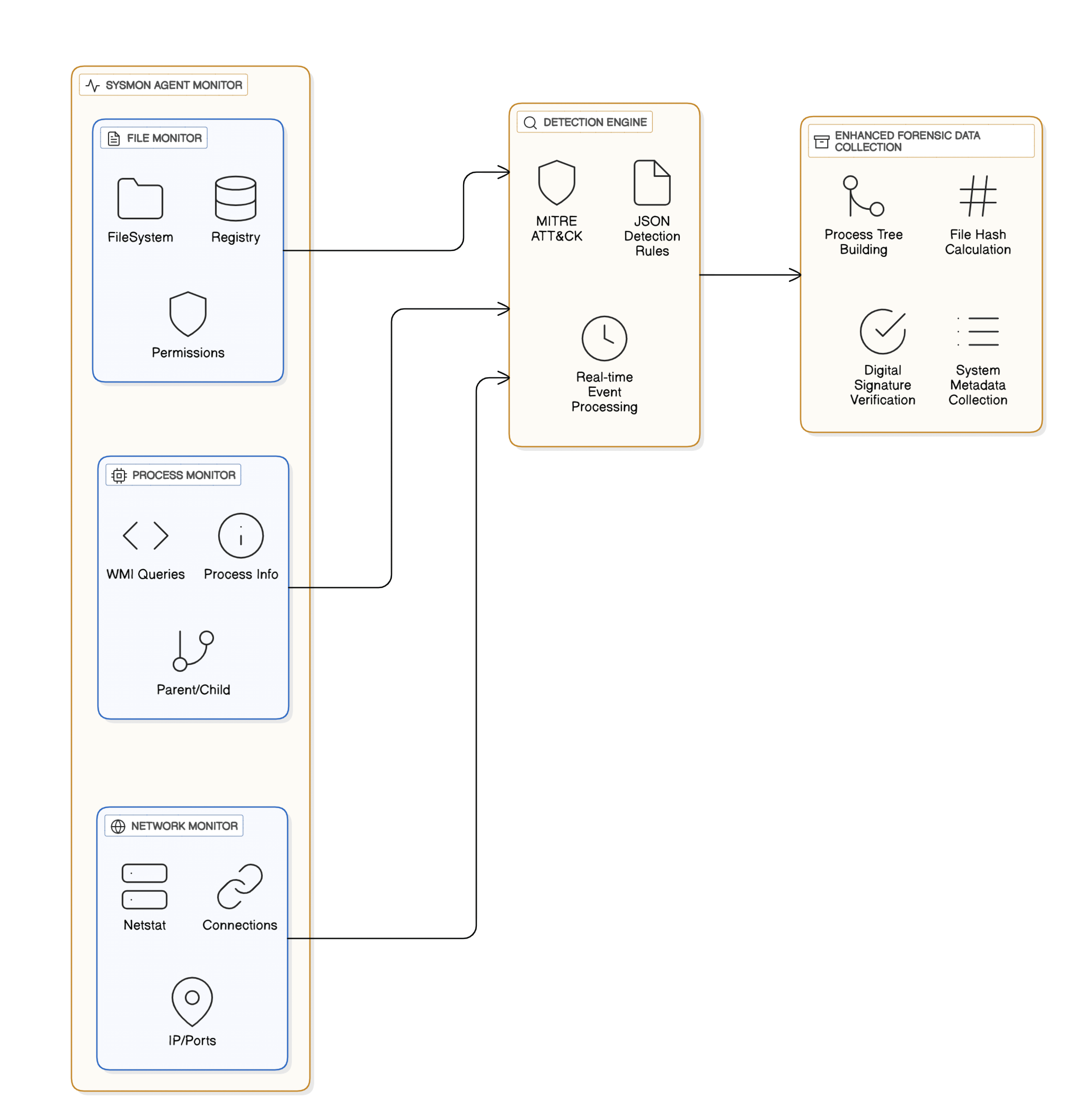
The agent is organized around:
- Separate collectors for file, process, and network telemetry
- A detection engine that applies JSON rules and MITRE context
- Enrichment services for process trees, hashes, signatures, and metadata
Agent inventory view
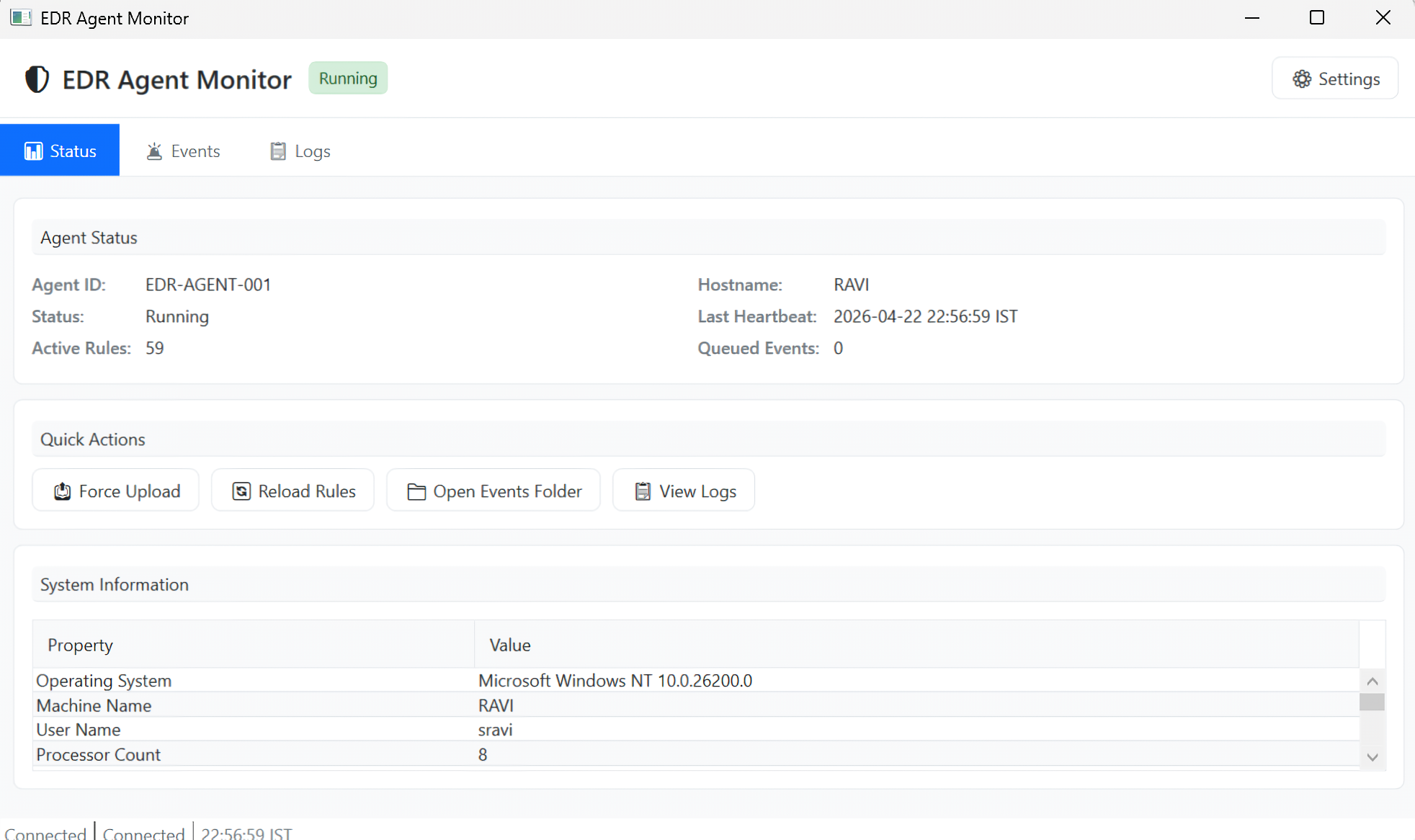
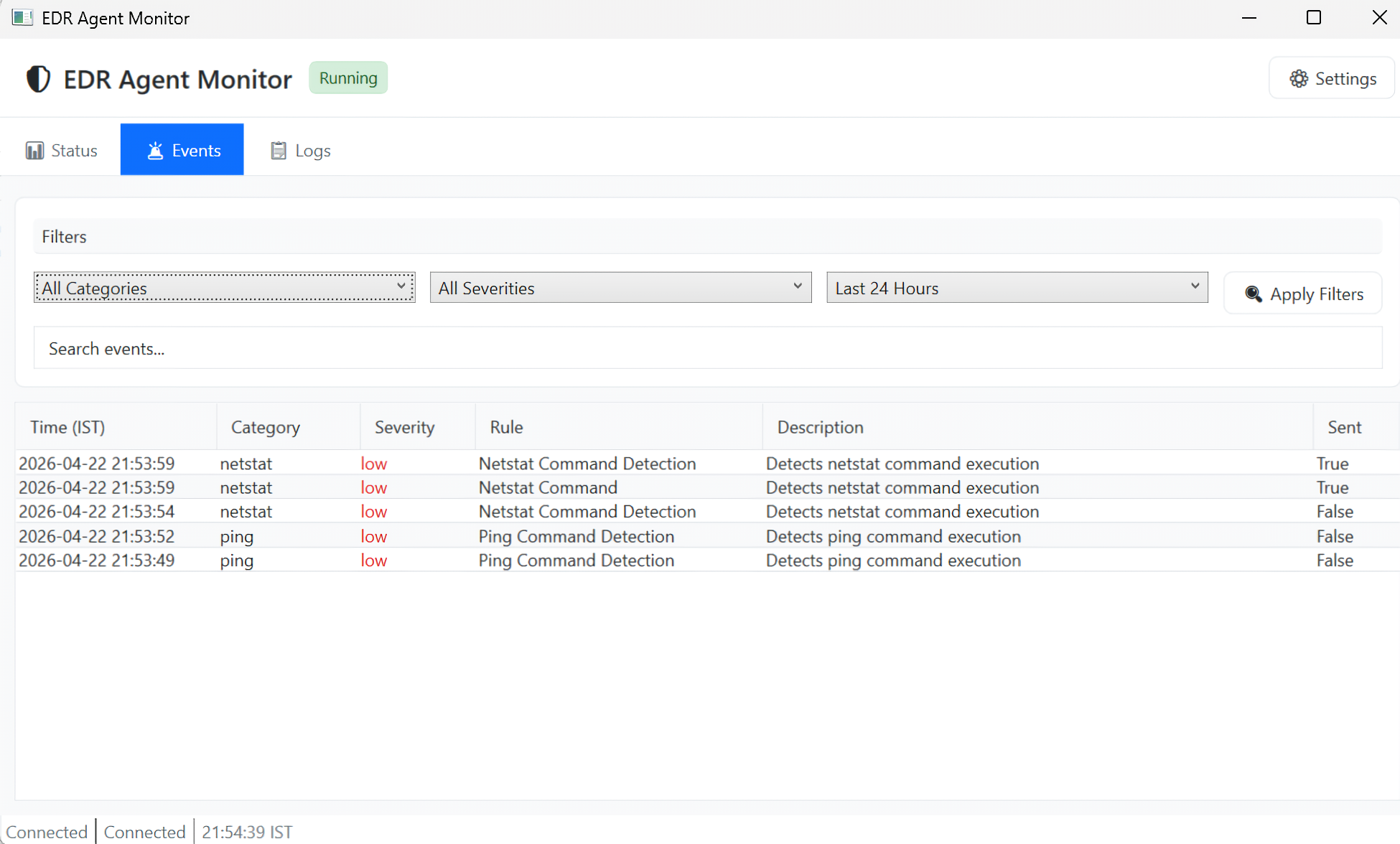
These screens show the operator-facing agent workflows:
- Service status and heartbeat health
- Local rule counts and upload settings
- Triggered events before or after delivery to the backend
- Quick operational actions such as upload, reload, and log review
Sysmon event coverage
| Event ID | Event type | Purpose |
|---|---|---|
| 1 | Process Creation | Logs new process execution with command-line arguments |
| 3 | Network Connection | Captures outbound TCP/UDP connections initiated by processes |
| 7 | Image Load | Records DLL and module loading events |
| 8 | CreateRemoteThread | Captures remote thread creation often associated with process injection |
| 10 | Process Access | Logs attempts by one process to access another |
| 11 | File Create | Logs creation of new files on the system |
| 12 | Registry Event Create/Delete | Captures creation or deletion of registry objects |
| 13 | Registry Value Set | Logs modifications to registry values |
| 14 | Registry Rename | Records renaming of registry keys or values |
| 15 | FileCreateStreamHash | Records alternate data stream creation and file hash information |
| 19 | WmiEventFilter | Captures WMI event filter activity used in persistence |
| 20 | WmiEventConsumer | Logs WMI event consumer activity used in persistence mechanisms |
| 22 | DNS Query | Captures DNS lookups performed by processes |
| 23 | File Delete Archived | Logs deleted files and stores metadata before removal |
| 25 | Process Tampering | Records attempts to modify a running process image or memory |
| 26 | FileDeleteDetected | Detects file deletion events useful for cleanup or defense evasion tracking |
Agent pipeline
- Read the event from Sysmon.
- Transform it into normalized fields.
- Evaluate matching rules.
- Enrich hits with local evidence.
- Correlate related records when local linkage is available.
- Place the alert in an upload queue.
- Send the payload to the cloud backend.
Operational design
- Runs continuously in the background
- Uses bounded local storage for queued data
- Retries failed uploads with backoff
- Avoids blocking endpoint activity during backend outages
- Separates collection, rule evaluation, enrichment, and upload into clear components